

Wild Mouse 750
Wild Mouse 750 (B6-Chr1YP1, No. D000750) has been developed to facilitate the study of obesity, fatty liver and other metabolic diseases. It possesses the wild mouse chromosome 1 on the C57BL/6JGpt background. It exhibits metabolic sensitivity making it a better model for metabolic disease research.
Key Features
Increased genetic diversity through the introduction of an entire chromosome from a wild mouse.
Clear genetic background (except Chr 1) and good reproductivity contributed by its parental C57BL/6JGpt genome
The genetic variations that contribute its metabolic phenotypes are naturally occurring, and located on chromosome 1.
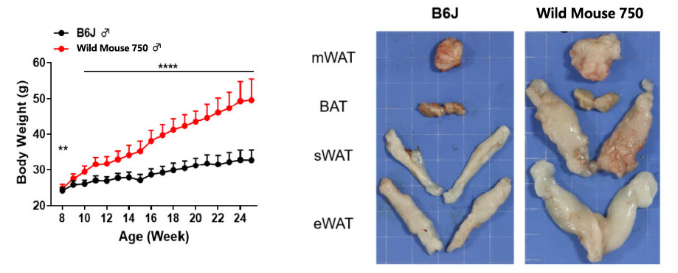
After 8 weeks of age, the body weight of 750 mice increased gradually. At 26 weeks of age, 750 and C57BL/6JGpt mice exhibited distinct tissue adiposity. The 750 mice had significantly enlarged adipose tissue at all depots. Mesenteric (m), subcutaneous (s), epididymal (e), white adipose tissue (WAT), brown adipose tissue (BAT).
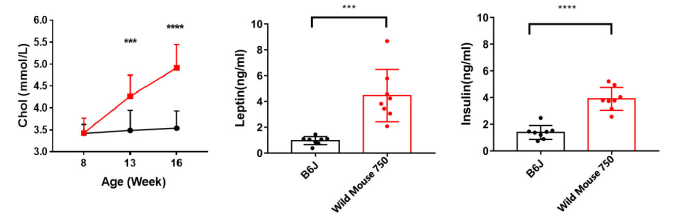
After 8 weeks of age, the cholesterol levels of 750 mice increased gradually, and at 9 weeks of age, leptin and insulin levels were significantly higher than those in C57BL/6JGpt control mice.
The disease characteristics of Wild Mouse 750 show more similarities to the human disease process than standard inbred mice and have a wide range of applications.
Obesity: This strain develops spontaneous obesity after 8 weeks of age, with significant increase in food intake and severe leptin resistance.
Abnormal glucose metabolism: Wild Mouse 750 exhibits mild and persistent hyperglycemia, insulin resistance, and glucose intolerance.
Abnormal lipid metabolism: Lipid levels (Chol, LDL-C, HDL-C) increase significantly after 8 weeks of age and continue to increase after Western diet (WD) feeding.
MASLD/MASH: Aged mice exhibit a distinct fatty liver phenotype. WD feeding accelerates the development of MASH, including steatosis, lobular inflammation, and moderate fibrosis, with clinical NAS score of 7 and above.
Metabolic Diseases Analysis Platform
Not only Wild Mouse 750 is an ideal model for metabolic research as described above, it can also be used in preclinical efficacy evaluation of products targeting weight loss, hypoglycemia, hyperlipidemia, and MASH.
With our proprietary mouse models and experienced scientific team, GemPharmatech offers a one-stop solution for metabolic disease research, including phenotyping and drug efficacy evaluation services to analyze metabolic, behavioral, and hematological indicators.
Services Available
| Metabolism | Neurobehaviroal | Cardiovascular | Blood and Immunology | Body Composition |
Metabolic cage Physiological cage Glucose tolerance test | Water maze Rotarod Open field | Blood pressure Electrocardiogram Cardiac ultrasound | FACS, ELISA CBC Blood biochemistry | Bone density Fat content |